
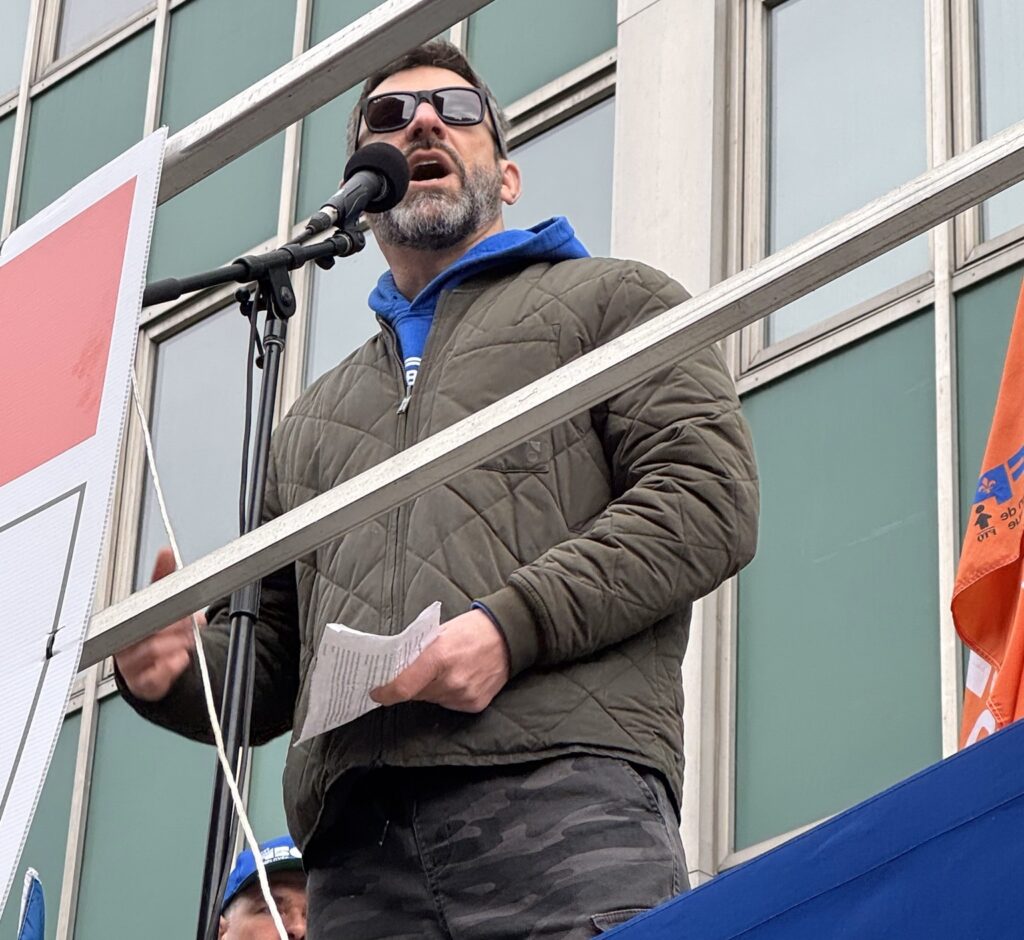
The filing of a memorandum by FTQ related to Bill #3 has generated several questions within our organization. To better understand the issues and potential implications, we reached out to Pierre-Guy Sylvestre, an economist and advisor at CUPE. A specialist in research, negotiations, and public affairs, he offers his insight into this controversial reform.
The government justifies this project in the name of transparency in union governance. What, in your opinion, does not hold water in this argument?
The unions are already transparent with their members, what the government is aiming at is to make the union structure more cumbersome and to destabilize it.
In your opinion, what is the real objective of Bill #3?
Attack union check-off by dividing the revenues related to dues. Alberta and U.S. states have used such reforms in the past, and the result has been lower unionization, lower wages, and higher workplace injuries and fatalities. Article 47 of the Labour Code is the result of trade union struggles and allows trade unions to be financed by stable incomes. Forcing unions to divide their revenues related to dues into a main and optional part will create discord and confusion among members, while exposing locals to fines that can run into tens of thousands of dollars.
FTQ says that this is an interference in union democracy. Do you share this statement? Why?
Indeed, I do. The unions are private organizations; they have no public funding. They are beholden to those who contribute to the union. CUPE local constitution, by-laws and internal affairs belong to its members.
Who asked for this bill, who was consulted?
The minister claims that he consulted the unions, but that is not true. No union would have asked for such a bill, it’s absurd. The law is illegal and the groups that support it are the Conseil du patronat, the Montreal Economic Institute and other conservative business groups. Fundamental rights must be respected; several lobbyists have ignored them.
What risks do you see for industrial peace and the equity of the Labour Code?
The provisions of the bill, which will probably be amended when the House resumes, provide that votes at meetings can no longer be held on the spot, and that all members will have to vote on the topics presented at these meetings, from 3 to 30 days after the meeting. This could make it more difficult to accept a tentative agreement because, according to union experience, a tentative agreement must be explained at length to be understood. There could be more labour disputes and more difficult settlements to obtain.
Why is the division between the main contribution and the voluntary contribution considered problematic?
Members are already voting for budgets that are detailed. If a union participates in a social movement, advertises or challenges the legality of a law in court, it will have to hold a meeting and have all the members vote for that specific budget. Then, the union will have to inform the employer to separate the contributions collected. This process must be done at least once a year, or whenever there is a change in the union’s agenda. The employer will then have to adjust the amount collected for the voluntary contribution and for the main contribution. Imagine all the Unions at Santé Québec changing their % of dues every year. Now imagine those same unions changing the percentage of each of the dues (principal and optional) once or several times per year. A disaster in the making.
What would be the concrete consequences of this reform for the financing and capacity of the unions to operate?
Members who are dissatisfied with the categorization of the shares into principal or facultative could ask the Court of Québec to sue their union to determine whether the main dues were wrongly used to finance an optional expense. The union will have to defend itself. Another member could then ask the Court of Quebec to sue his union if the defense is assumed by the main dues revenues and so on.
How would the new requirements for annual votes and referendums be bureaucratic or unenforceable?
Employers would have a hard time keeping up and members would be demobilized by having to constantly come back to assemblies when they voted on a budget.
The bill restricts the use of union funds to challenge laws or government decisions. Why does the FTQ consider this dangerous?
Yes. The separation of powers is important and guarantees the well-being of the population. A Prime Minister cannot decree what he wants or cannot adopt laws that would go against the Charters of Rights and Freedoms, and that is why the judiciary exists.
What consequences could this have for the defense of workers’ fundamental rights?
It would be weakened.
Is there a risk that the unions will be unable to act as a democratic counter-power?
This is the main issue here.
The bill imposes mandatory 24-hour votes. How can this harm deliberative democracy in assemblies?
The unions can have these compulsory votes adopted; it is their prerogative. We are denouncing the interference here.
Does this measure open the door to employer interference in union decisions?
Yes, the employer will have time to start fear campaigns and make threats.
If this project is adopted, what will the unions have to do to adapt or resist?
Contest in court because this law is illegal!
What should the government do if it really wants to improve transparency?
Mind its own business!
What alternatives or modifications do you think would be acceptable or constructive?
None!
The FTQ is calling for the complete withdrawal of the bill. Do you share this position?
Yes!
Katia Idir et Patrick Hallé