
Anyone who has been to Turin in Italy, a city very dear to my heart, has probably visited the Egyptian Museum of Turin or the Museum of Egyptian Antiquities of Turin (Fondazione museo delle antichità egizie di Torino). This museum has one of the most important Egyptological collections in the world.
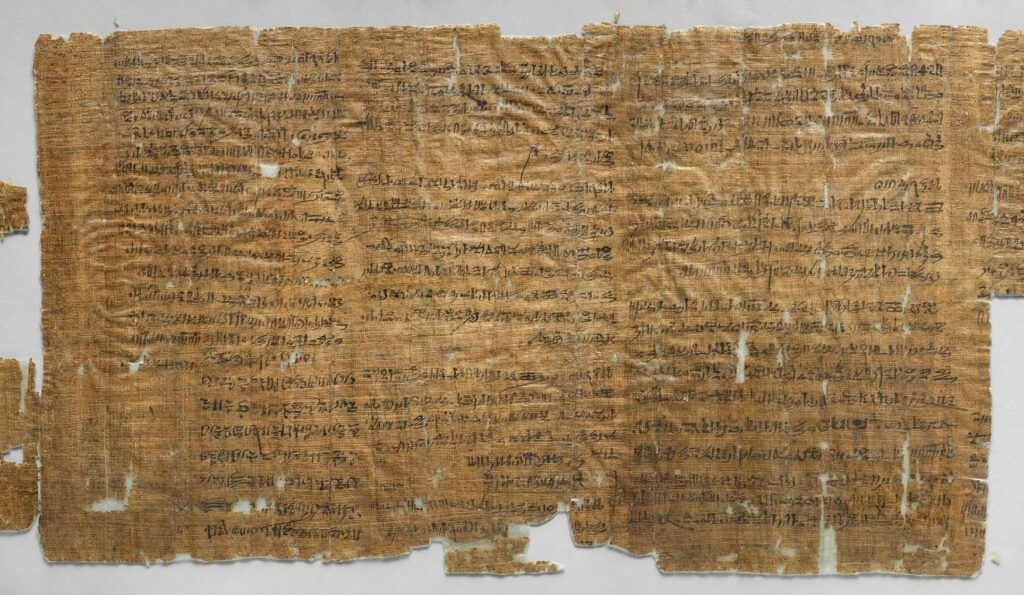
Among all the treasures of ancient Egypt in this museum is the “Strike Papyrus”. This papyrus is the first “journalistic” document relating the facts of the first strike in the history of humanity. Written by the scribe Amennakht in 1166 BC, it tells the story of the demonstrations that took place in Deir el-Medineh.
Despite the relative prosperity of Deir el-Medineh and the majestic achievements of the previous reign of Ramses II, the year 1166 BC is a turning point in the history of the working-class village of Seth Ma’at. It was in this ancient Egyptian village, located near the Valley of the Kings, that the working population participated in the construction of the various tombs in the valley. Ramses III, successor of Ramses II, inherited an Egypt weakened by conflicts against the “peoples of the sea”, i.e., the invading peoples arriving from the Mediterranean Sea, who tried several times to invade the Egyptian kingdom.
These challenges, combined with growing corruption and problems with agricultural yields, accompanied by Ramses III’s outsized ambition to match the architectural feats of his predecessor, are putting considerable financial pressure on the state, which is on the verge of exploding.
It was, therefore, in this tense context that the first documented strike took place in Deir el-Medineh. In 1166 BC, the state coffers were almost empty, and the workers (known as “artisans” at the time) suddenly found themselves deprived of their wages. They fed and clothed and gave fabrics that they could barter in the markets. Ramses III, in his quest to build a monumental tomb, decided to expand the team of workers to 120 men, a number that the state could not afford to pay.
Supplies, traditionally distributed by royal officials as salaries, stopped being given. This prompted the workers to take a radical step, which is detailed in the “Strike Papyrus” kept in the Egyptian Museum in Turin. The scribe Amenakht recounts the beginning of the strike, describing how the workers and their sympathizers, starving after 18 days without pay, settled in the back of the temple of Thutmose III, staging a siege.
The first Common Front?
This strike movement became a real revolution for the time, soon joined by their families, followed by the non-workers who depended on the economic activity of the workers.
The latter, led by hunger and revolt, demonstrated in front of the temples in the region, because they knew that these places were essential economic relays of the royal administration. The temples provided part of the remuneration in kind, as evidenced by the inscriptions on jars found in the village. These vessels came from the great temple of Ramses II, in the necropolis.
The scribe Amenakht, normally in charge of recording the details of the work, became the privileged “scribe journalist” of this social movement unprecedented in all history.
While the authorities ordered the workers to return to work. The latter refused to comply and organized a siege.
They write a statement that is noted on the famous papyrus, and which translates as follows:
“If we have come to this point, it is because of hunger and thirst; there are no more clothes, no ointments, no fish, no vegetables! Write to Pharaoh, our good lord, on this subject, and write to the Vizier, our superior, to have the provisions given to us.”
They therefore directly asked the Pharaoh and the Vizier to take immediate measures to ensure their survival.
This is unusual for the period and culture of the time.
The workers of Deir el-Medineh wrote, through this action, an unprecedented chapter of workers’ resistance, underlining the collective strength in the face of adversity and individualism, but in the face of power, thus marking a singular moment in the history of ancient Egypt, but also in the entire history of trade unions.
“NOT HAPPY! NOT HAPPY! NOT HAPPY! —The mythical scene from the movie “Asterix and Obelix: Mission Cleopatra” may not be so fake after all.